Getting Around Kelowna: Driving, Transit, Traffic & Commute Times
📖 Estimated reading time: 7 minutes
If you're thinking about moving to Kelowna, getting around the city might look pretty straightforward on a map.
And in many ways, it is.
But Kelowna's geography creates a few transportation quirks that aren't always obvious until you've lived here.
Highway 97 runs through the region, Okanagan Lake divides Kelowna from West Kelowna, and many of our residential neighbourhoods extend into the surrounding hills.
Where you live can make a noticeable difference to your commute, how often you use your car and how easily you can walk, bike or take transit.
Here's what you should know before choosing where to live.
🚗 Getting Around Kelowna at a Glance
For most residents, driving is still the primary way to get around.
Kelowna does have public transit, an expanding cycling network and some very walkable neighbourhoods, but the city is relatively spread out.
A few things to understand:
- Highway 97 is the main transportation corridor through the region.
- The William R. Bennett Bridge is the only direct road connection between Kelowna and West Kelowna.
- Walkability varies considerably depending on the neighbourhood.
- BC Transit serves Kelowna, West Kelowna, Lake Country and Peachland.
- Kelowna has an extensive and growing cycling and active-transportation network.
- Winter driving within the city can be very different from driving the mountain highways surrounding the Okanagan.
If you're still researching the region more broadly, you can start with my complete guide to moving to Kelowna.
🛣️ Highway 97: Kelowna's Main Transportation Corridor
Highway 97 is essentially the transportation spine of the Central Okanagan.
It connects West Kelowna, Kelowna and Lake Country and continues north toward Vernon and south toward Peachland and Penticton.
Within Kelowna, Highway 97 runs through the city as Harvey Avenue.
That makes access to Highway 97 an important consideration when choosing where to live — particularly if your work, children's activities or everyday routine regularly take you from one end of the city to another.
Kelowna doesn't have a large freeway network surrounding the city like you might be accustomed to in Calgary, Edmonton or Toronto.
Instead, much of the region's traffic ultimately funnels toward the same major corridor.
🌉 The Bridge Matters More Than You Might Think
If you're considering West Kelowna, the William R. Bennett Bridge becomes part of the equation.
It's the only direct road crossing between West Kelowna and Kelowna and carries Highway 97 across Okanagan Lake.
That doesn't mean you shouldn't live in West Kelowna and work in Kelowna — thousands of people do.
But it does mean the bridge becomes a regular part of your routine.
Traffic can vary considerably depending on the time of day, season, weather, construction or an accident, which is why I don't think giving someone a single "typical commute time" is particularly helpful.
If you'll regularly need to cross the bridge for work, school or activities, think about that as part of your neighbourhood decision rather than simply comparing the distance between two addresses.
For a deeper look at the differences between living on either side of the lake, read my Kelowna vs. West Kelowna comparison.
⏰ What Is Kelowna Traffic Really Like?
If you're moving from Vancouver or Toronto, Kelowna traffic may feel relatively manageable.
But that doesn't mean we don't have congestion.
Weekday morning and afternoon commute periods are naturally busier, and summer brings another variable: visitors.
Kelowna is a major tourism destination, so summer traffic can sometimes be busier than newcomers expect.
The bridge and portions of Highway 97 are particularly sensitive to congestion because there are limited alternative routes when something disrupts traffic.
Construction is also a regular reality in a growing city.
Typical weekday drive times
To give you a feel for everyday driving, here are approximate ranges for a few common trips. They are based on Google Maps' typical-traffic estimates for weekday departures at 8:00 a.m. and 12:30 p.m., checked in October 2026.
| Trip | Approximate drive time |
|---|---|
| Black Mountain → Downtown Kelowna | 16–40 min |
| West Kelowna → Downtown Kelowna | 16–35 min |
| Lake Country (Winfield) → Downtown Kelowna | 22–40 min |
| Black Mountain → Kelowna International Airport (YLW) | 14–24 min |
| Downtown Kelowna → UBC Okanagan | 16–26 min |
Starting points: Black Mountain Elementary School, West Kelowna City Hall, Lake Country Municipal Hall in Winfield, and Kelowna City Hall for Downtown. These are estimates, not guaranteed travel times. Traffic, bridge congestion, construction, weather and time of day can all change how long a trip takes.
For current road conditions, closures, incidents and highway information, DriveBC is the best resource to bookmark:
🚌 What Is Public Transit Like?
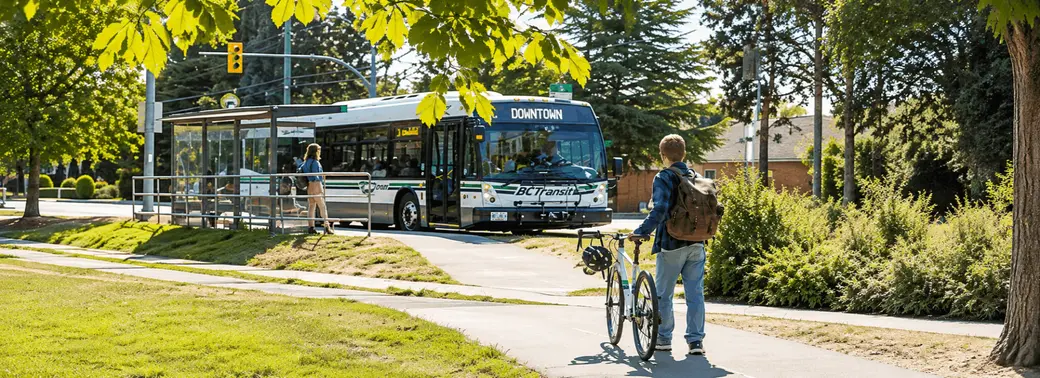
The Kelowna Regional Transit System, operated by BC Transit, serves Kelowna as well as West Kelowna, Lake Country and Peachland.
The network is entirely bus-based — there is no SkyTrain or light-rail system.
The main rapid-bus corridor follows Highway 97 and connects several major destinations through the region, including Downtown Kelowna, Orchard Park and the UBC Okanagan area.
Whether transit will work well for you depends heavily on where you live and where you need to go.
Someone living near a major transit corridor may be able to rely on transit much more easily than someone living in one of Kelowna's hillside neighbourhoods.
That said, a few routes are useful to know as you compare neighbourhoods (based on BC Transit's Rider's Guide effective September 6, 2026):
- 97 Okanagan – the rapid line along Highway 97, linking Westbank, Downtown Kelowna (Queensway Exchange), Orchard Park and UBC Okanagan.
- 14 Black Mountain – connects Black Mountain with Rutland Exchange, where you can transfer to other routes.
- 23 Lake Country – runs between UBC Okanagan and Winfield's Berry Transit Exchange, with some trips stopping at Kelowna International Airport.
- 90 UBCO/Vernon – a regional route operated by Vernon Regional Transit that connects UBC Okanagan with Downtown Vernon. It uses regional fares rather than standard Kelowna fares.
Rather than relying on a list of routes that could change, you can check current schedules and plan a trip directly through BC Transit:
https://www.bctransit.com/kelowna/
If you're budgeting for transportation as part of your move, I've also covered transit and other everyday expenses in my Cost of Living in Kelowna guide.
🚶 Can You Live in Kelowna Without a Car?
It depends considerably on where you live.
Some central areas make it possible to walk or bike to restaurants, groceries, parks and everyday amenities.
Once you move farther into Kelowna's suburban and hillside communities, having a vehicle becomes much more practical.
This is one reason I encourage people relocating here to think about their daily routine, not just the house itself.
A beautiful home may check every box, but if you're driving across the city several times a day for work, school and activities, location can have a surprisingly big impact on how you experience living here.
Rather than repeating every neighbourhood here, my guide to Kelowna's neighbourhoods breaks down which areas tend to offer greater walkability and which are more car-dependent.
🚲 Getting Around by Bike
Cycling is becoming an increasingly practical option in parts of Kelowna.
The city continues to expand its active-transportation network with bike lanes, protected routes and multi-use pathways.
One of the region's best-known routes is the Okanagan Rail Trail, a relatively flat multi-use corridor following a former railway route north from Kelowna through Lake Country and toward the North Okanagan.
It's used for both recreation and everyday cycling and is one of the features that makes travelling between some parts of the region by bike more realistic.
You can find current information about the trail and connections here:
https://www.kelowna.ca/roads-transportation/active-transportation/okanagan-rail-trail
❄️ Winter Driving Is Worth Understanding
If you're moving from somewhere with mild winters, there are really two different conversations when it comes to winter driving here.
Driving around Kelowna and driving in and out of the Okanagan aren't necessarily the same experience.
Kelowna gets snow and icy conditions, and hillside neighbourhoods can be more challenging during winter weather than areas on the valley floor.
But the mountain highways connecting the Okanagan to other parts of BC can experience significantly more severe winter conditions.
The Okanagan Connector and Coquihalla are mountain highways, and conditions can change quickly.
Winter tires or chains are legally required on many designated BC highways during the winter season, so this is something newcomers should understand before travelling outside the valley.
On designated provincial highways, winter tires (or chains, where signs require them) are required from October 1 to April 30 on most routes, including mountain passes and high-snowfall areas. On select highways outside those areas, the requirement ends March 31. Designated routes are marked with regulatory signs. City and municipal streets aren't covered by these provincial highway designations, so the same dates don't automatically apply to every road in Kelowna, but good winter tires are still a smart choice here, especially in hillside neighbourhoods. A legal winter tire in BC has at least 3.5 mm of tread and carries either the M+S (mud and snow) or the three-peaked mountain and snowflake symbol.
Want a better sense of what each season actually feels like? Read my Weather in Kelowna guide.
Before a winter road trip, check:
You can also review BC's current winter tire requirements here:
✈️ Getting to Kelowna International Airport
One transportation advantage that's easy to appreciate once you live here is having Kelowna International Airport (YLW) right in the city.
YLW is located in North Kelowna near UBC Okanagan.
For people who travel frequently for work or to visit family, proximity to the airport may actually be worth considering when choosing a neighbourhood.
Residents in northern parts of Kelowna generally have more convenient airport access, while those living farther south or across the bridge have a longer trip.
I wouldn't choose a neighbourhood based solely on the airport, but if you're flying several times a month, it can certainly become part of the equation.
🅿️ What About Parking?
Parking is generally straightforward throughout much of Kelowna, but Downtown and South Pandosy are different from suburban areas.
Downtown Kelowna has a combination of paid on-street parking, parkades and private lots.
The City uses licence-plate-based payment for its paid on-street parking areas, and parking rules vary by location and time.
Rather than listing rates and hours that may change, you can check the City's current parking information here:
https://www.kelowna.ca/roads-transportation/parking/about-parking-services
If you're considering buying a condo Downtown or in another higher-density area, I would also look carefully at the parking included with the property. One stall versus two — or visitor parking availability — can matter considerably depending on your household.
🏡 How Transportation Should Affect Your Home Search
This is where transportation becomes a real estate consideration.
Before choosing a neighbourhood, think about where you'll regularly need to go.
Where will you work?
Where will your children go to school or daycare?
How often will you travel across the bridge?
Do you want to walk to restaurants and coffee shops?
Do you travel frequently through YLW?
Are skiing, boating, biking or golfing regular parts of your lifestyle?
Your answers can change which part of the Central Okanagan makes the most sense.
Families may also want to look at transportation alongside school catchments and activities. My Schools in Kelowna guide explains how the local school system and catchments work.
Once you've narrowed down the areas that suit your daily routine, you can explore homes for sale in Kelowna and the surrounding communities to see what's currently available.
🌿 Meghan's Local Insight
One thing I'd encourage anyone relocating to Kelowna to do is test-drive your potential routine, not just the neighbourhood.
If you have the opportunity while you're visiting, drive from the home or neighbourhood you're considering to work, school, groceries or the activities you'll use regularly.
And don't only do it on a quiet Sunday afternoon.
Seeing what that route feels like during a normal weekday can tell you much more about whether the location works for your lifestyle.
Sometimes a home that's slightly farther away on a map can actually work better because of how you access the places you use every day.
❓ Frequently Asked Questions
Do I need a car to live in Kelowna?
For most people, having a vehicle is the most practical option. However, people living in some central neighbourhoods may be able to walk, cycle or use transit for a larger portion of their everyday trips.
Does Kelowna have rapid transit?
Kelowna's public transportation system is bus-based. BC Transit operates a rapid-bus corridor along Highway 97, but the region doesn't have a rail transit system such as SkyTrain or LRT.
Is traffic bad in Kelowna?
Kelowna experiences congestion during weekday commute periods and the busy summer season, particularly along Highway 97 and around the William R. Bennett Bridge. How much it affects you depends considerably on where you live and where you regularly travel.
Is Kelowna bike-friendly?
Kelowna has a growing network of cycling and multi-use routes, including the Okanagan Rail Trail. Cycling practicality varies considerably by neighbourhood.
Do I need winter tires in Kelowna?
Winter tires or chains are required on many designated BC highways during the winter season. Mountain highways surrounding the Okanagan can experience much more severe winter conditions than roads within the city.
Is parking free in Downtown Kelowna?
Some parking is paid and some is free depending on the location, day and time. Check the City of Kelowna's current parking information before relying on specific rates or restrictions.
📚 Continue Exploring the Living Okanagan Resource Centre
- Moving to Kelowna: Everything You Need to Know Before You Move
- Cost of Living in Kelowna
- Best Neighbourhoods in Kelowna
- Kelowna vs. West Kelowna: Which Is Better for You?
- Weather in Kelowna: What to Expect Year-Round
- Schools in Kelowna: What Families Should Know Before Moving
- Healthcare in Kelowna: What to Know Before You Move
Thinking About Moving to Kelowna?
Where you live can have a bigger impact on your everyday routine than you might expect.
If you're comparing neighbourhoods or trying to figure out which part of the Central Okanagan best fits your commute, family and lifestyle, I'd be happy to help you narrow it down.
The goal isn't simply to find the right home — it's to find a location that makes sense for the way you actually want to live.
Categories
Recent Posts