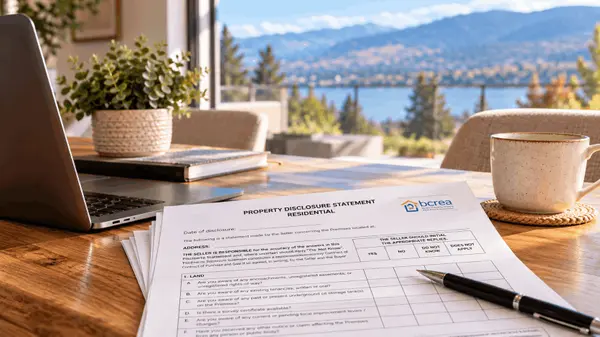
Selling a Strata Property in the Central Okanagan: What Sellers Need to Know

📖 Estimated reading time: 7 minutes
Selling a condo or townhouse in the Central Okanagan is a little different from selling a detached home.
You're not only selling your individual unit. Buyers are also looking at the strata corporation — its finances, insurance, bylaws, upcoming projects and plans for the building or development.
That means some of the most important preparation happens before your property ever hits the market.
If you're thinking about selling a strata property in Kelowna, West Kelowna, Lake Country or elsewhere in the Central Okanagan, here's what you should know.
For a broader look at the entire selling process: Selling Your Home in the Central Okanagan: A Complete Guide
What Makes Selling a Strata Property Different?
When someone buys a strata property, they're buying their strata lot along with an interest in the common property and common assets of the strata corporation.
So while buyers will certainly care about your kitchen, flooring, view and the condition of your unit, they'll usually investigate much more than that.
They may also look at:
- Monthly strata fees
- The Contingency Reserve Fund (CRF)
- Upcoming repairs or major projects
- Special levies
- Insurance and deductibles
- Depreciation reports
- Meeting minutes
- Bylaws and rules
- Parking and storage
- Pet restrictions
- Short-term rental restrictions
- Age restrictions
- Renovation approvals
In other words, buyers aren't only evaluating your home. They're also trying to understand the strata corporation they're buying into.
Getting the Strata Documents Ready
One of the things I take care of early when listing a strata property is ordering and reviewing the relevant strata documents.
There can be quite a bit of paperwork involved in a strata sale, but this isn't something I expect my sellers to track down themselves.
If you already have copies of some of the documents, that's helpful, but I'll still make sure we're working with the most recent information available.
Depending on the property, I'll typically review things such as:
- Form B Information Certificate
- Current bylaws and rules
- Recent council, AGM and SGM minutes
- Current operating budget and financial information
- Most recent depreciation report, if applicable
- Current strata insurance information
- Approved or proposed special levies
- Relevant engineering or building reports
- Parking and storage information
There may also be records that you have personally that aren't part of the standard strata package — such as renovation approvals, alteration agreements, permits or correspondence relating specifically to your unit.
If you have those, great. If not, we'll figure out what we actually need rather than having you chase down paperwork unnecessarily.
What Is a Form B?
You'll probably hear the term Form B when selling a strata property.
It's essentially an information certificate that provides important details about the strata corporation and your particular strata lot.
Among other things, it can include information about:
- Monthly strata fees
- Money owing to the strata
- Approved special levies
- The Contingency Reserve Fund
- Certain pending resolutions
- Legal proceedings involving the strata
- Parking and storage
- Strata insurance
It also comes with important supporting documents, including the current budget, strata rules and the most recent depreciation report, if there is one.
I handle ordering the Form B as part of preparing the property for sale.
It's also worth knowing that a Form B doesn't have a set statutory expiry date. It's better to think of it as a snapshot of the strata at a particular point in time.
If something significant changes while your property is listed — perhaps an AGM occurs or a special levy is approved — we may need updated information.
Depreciation Reports and the Central Okanagan
A depreciation report looks at the condition and expected lifespan of major common-property components and estimates future repair and replacement costs.
Depending on the property, that could include things like:
- Roofs
- Building envelopes
- Windows
- Elevators
- Mechanical systems
- Paving
- Other major common-property assets
For strata corporations with five or more strata lots, depreciation reports are now generally required on a five-year cycle. Stratas with four or fewer lots are exempt.
What About the Central Okanagan?
There's an important transition happening right now.
For applicable strata corporations in the Central Okanagan, the transition deadline is July 1, 2027.
That means a local strata without a current depreciation report isn't necessarily non-compliant today.
When I'm preparing a strata property for sale, I'll want to obtain the most recent depreciation report available. Even if you already have a copy, I'll still confirm that we're looking at the current one.
What Will Buyers Look for in a Depreciation Report?
A depreciation report can give buyers a better understanding of what major work may be coming.
For example, they may see that a roof, elevator or other major component is approaching the end of its projected lifespan.
That doesn't automatically mean there's a problem.
It may simply lead to questions such as:
How much money is in the Contingency Reserve Fund?
Has the strata been planning for this expense?
Has a special levy been discussed?
Are strata fees likely to need adjustment?
A depreciation report includes information about the condition of common property and assets, long-term cost projections and different funding models.
That's why I like to understand what's in the report before buyers start asking questions.
Are Low Strata Fees Always Better?
Not necessarily.
Low strata fees can certainly be attractive, but the monthly number doesn't tell the whole story.
A lower fee might reflect a building with fewer amenities or efficient operating costs. It could also mean less money is being set aside for future expenses.
Similarly, higher strata fees don't automatically mean a strata is poorly managed.
Buyers may look at the monthly fee alongside things such as:
- The operating budget
- CRF balance
- Depreciation report
- Insurance costs
- Special levy history
- Upcoming projects
- Meeting minutes
There isn't one magic number that tells you whether a strata is financially well prepared. It's the bigger picture that matters.
What About Special Levies?
A special levy is money collected from owners for a specific expense outside the regular operating budget.
For example, a strata might approve a special levy to help pay for a major repair or capital project.
An approved levy should appear in the strata information, but buyers may also review meeting minutes and the depreciation report for projects that are still being discussed and haven't resulted in an approved levy yet.
Who Pays a Special Levy When a Property Sells?
This is a common question, and the answer isn't always simply “the seller.”
Under BC's default rule, the seller is responsible for portions of an approved levy payable before completion, while the buyer is responsible for portions payable on or after completion.
However, the Contract of Purchase and Sale can change how that cost is allocated.
So if there's a special levy when you're selling, we'll look at the payment dates and the terms of the offer rather than making assumptions.
Strata Insurance Doesn't Cover Everything
The strata corporation generally carries insurance for the building, common property and common assets.
Owners should still have their own insurance.
Depending on the policy, an owner's coverage may include things such as:
- Personal belongings
- Improvements made to the unit
- Personal liability
- Additional living expenses after a loss
- Exposure to the strata corporation's insurance deductible
Insurance deductibles can be significant, which is one reason buyers often pay close attention to the strata's current insurance information.
This is another area I'll review as part of the strata documents before we list.
Can a BC Strata Still Restrict Rentals?
BC strata corporations can no longer enforce bylaws that prohibit or restrict long-term residential rentals.
You may still see older rental-restriction bylaws in a strata's bylaw package, but those restrictions are no longer enforceable. That can sometimes cause confusion when buyers are reviewing older strata documents.
Short-term rentals are different.
A strata corporation can still restrict or prohibit short-term rentals through its bylaws. Municipal and provincial short-term rental rules can also apply separately.
So if you're selling a property that may have short-term rental potential, I would verify all three layers before marketing it that way:
Strata bylaws + municipal rules + provincial rules.
Those rules have changed considerably in recent years and can vary by property.
Are 55+ Strata Buildings Still Allowed?
Yes.
This is another area where BC's rules changed, but 55+ strata bylaws are still permitted.
What changed is that 55+ is now the only age restriction a strata corporation can have. Other age limits, such as the 19+ restrictions that were once common, are no longer allowed.
There are also important exemptions to 55+ restrictions. These can include:
- Someone who was already lawfully living in the home when the 55+ bylaw was adopted
- A younger spouse or partner
- A live-in caregiver
- Certain children, including adult children in qualifying circumstances
So a 55+ bylaw doesn't necessarily mean every single person living in the home must personally be 55 or older.
If this is relevant to a buyer or seller, I would check the current legislation and the particular strata's bylaws rather than make assumptions based on the “55+” label alone.
Pets, Parking and Storage Matter Too
Pet bylaws can differ significantly between strata corporations, including the number or type of pets permitted.
If your pet is allowed because of an older bylaw or exemption, that also doesn't necessarily mean a buyer's new pet will be treated the same way.
Parking and storage can be surprisingly complicated too.
A parking stall may be part of the strata lot, limited common property or held under another arrangement.
So before advertising something like “two parking stalls,” I want to verify exactly what comes with the property.
It's a small detail until it isn't — particularly when parking or storage is important to a buyer.
What If You've Renovated Your Condo or Townhouse?
If you've completed renovations, this is one area where I may ask you for paperwork you already have.
Depending on the work and the strata's bylaws, certain alterations may have required strata approval.
If you happen to have things like:
- Written strata approval
- Permits
- Alteration agreements
- Contractor invoices
keep them handy.
If you don't have everything or aren't sure what was required, don't panic. We'll look at what was done and determine what information we actually need.
What Do Strata Sellers Need to Disclose?
The same general BC seller-disclosure principles apply to strata properties, but issues can sometimes involve the building or strata corporation, not just your individual unit.
That's why I want sellers to tell me about anything they're aware of that could potentially be relevant.
That might include:
- Water intrusion or leaks
- Major repairs under discussion
- Special levies
- Insurance claims involving the unit
- Unapproved renovations
- Bylaw disputes involving the unit
- Work orders
- Significant mould, pest, odour or noise issues
- Problems with parking or storage
Not everything on that list automatically becomes a legally required disclosure. The circumstances matter.
But I'd rather know about something before we list so we can determine how it should be handled.
For a more detailed explanation: What Do Sellers Have to Disclose When Selling a Home in BC?
What About Leasehold Strata Properties?
The Central Okanagan also has leasehold strata properties, including properties associated with First Nations land.
These transactions can be different from conventional freehold strata ownership.
Depending on the property, there may be additional considerations involving the remaining lease term, lease payments, financing, transfer requirements and the particular terms of the lease.
If your strata property is leasehold, we'll want to understand those details before putting it on the market.
For more information: Leasehold vs. Freehold Property in the Okanagan
What I'll Review Before We List
You don't need to arrive at our first conversation with a folder full of strata documents.
I'll take care of ordering the relevant documents and making sure we're working with current information.
Before we go to market, I'll generally want to understand:
- The current strata fees
- The strata's bylaws and rules
- What's been happening in recent strata meetings
- The strata's finances and Contingency Reserve Fund
- The most recent depreciation report, if applicable
- Current insurance and deductibles
- Approved or proposed special levies
- Upcoming major projects
- Parking and storage arrangements
- Any issues involving your particular unit that could affect the sale
What I may need from you is much simpler.
If you have paperwork relating specifically to your home — perhaps renovation approvals, permits or information about a previous insurance claim — keep it handy.
And if you don't have something or aren't sure whether it's relevant, don't worry. We'll figure out what we actually need together.
Meghan's Local Insight
With a strata sale, I don't like waiting until an offer comes in to start figuring out what's happening with the building.
I'd rather order and review the documents early.
If there's a major project coming, a high insurance deductible, a proposed levy or an unusual bylaw, that doesn't necessarily mean there's something wrong with the property or that it will be difficult to sell.
It means we should understand it before buyers start asking questions.
The same goes for your individual unit. If you've renovated, had a leak repaired, dealt with an insurance claim or have an unusual parking arrangement, tell me about it.
Sometimes the answer is simply gathering the right information.
The fewer surprises we encounter once a buyer is interested, the smoother the transaction tends to be.
Frequently Asked Questions
Do I need to order my own strata documents before selling?
No. I generally take care of ordering the relevant strata documents and confirming that we're working with current information. If you already have documents, that's helpful, but you don't need to start tracking everything down yourself.
What is a Form B?
A Form B is an information certificate containing important information about the strata corporation and the particular strata lot. I arrange this as part of preparing the property for sale.
Are low strata fees better?
Not necessarily. Strata fees make more sense when they're considered alongside the operating budget, Contingency Reserve Fund, depreciation report, insurance costs and upcoming projects.
Can a BC strata ban rentals?
A strata can no longer enforce bylaws prohibiting or restricting long-term residential rentals. Short-term rentals are different and can still be restricted or prohibited by a strata.
Are 55+ strata buildings still allowed in BC?
Yes. Strata corporations can still have 55+ age-restriction bylaws, although there are important exemptions for certain residents, younger spouses or partners, caregivers and certain children.
Who pays a special levy when I sell?
It depends on the payment dates and the Contract of Purchase and Sale. Under the default BC rule, the seller is responsible for portions payable before completion and the buyer for portions payable on or after completion, but the contract can change that allocation.
Does my Kelowna strata need a depreciation report right now?
Stratas with five or more lots are subject to the current depreciation-report requirements, but applicable Central Okanagan stratas have a transition deadline of July 1, 2027. A strata without a current report today isn't automatically non-compliant.
Continue Exploring
Selling Your Home in the Central Okanagan: A Complete Guide
What Do Sellers Have to Disclose When Selling a Home in BC?
Leasehold vs. Freehold Property in the Okanagan
Moving to Kelowna: What You Need to Know Before You Move
Best Neighbourhoods in Kelowna
Thinking About Selling Your Strata Property?
If you're considering selling a condo or townhouse in Kelowna, West Kelowna, Lake Country or elsewhere in the Central Okanagan, we can start by looking at your property and what's happening with the strata.
I'll take care of ordering and reviewing the relevant strata documents, so you don't need to worry about figuring all of that out before we get started.
That gives us a chance to identify questions early, understand what buyers are likely to look at and put together a selling strategy that makes sense for your property.
Have questions about selling your strata property? Get in touch — I'm always happy to chat.
Categories
Recent Posts