Selling Your Home in the Central Okanagan: A Complete Guide

📖 Estimated reading time: 10 minutes
Selling a home is a big financial decision, but it’s also a very personal one.
Maybe you’re moving to a different neighbourhood, downsizing, relocating out of the Okanagan, selling an investment property, or trying to coordinate the sale of your current home with the purchase of your next one.
Whatever the reason, there’s more to a successful sale than putting a sign on the lawn and waiting for an offer.
From pricing and preparation to disclosures, offers, closing costs and possession day, understanding the process ahead of time can make the experience much easier.
This guide walks through what homeowners should know about selling a home in Kelowna and the Central Okanagan, including a few local considerations that can affect your sale.
The Home-Selling Process in BC
Every sale is a little different, but most follow a similar path:
- Meet with a REALTOR® and discuss your goals and timeline.
- Review your property's current market value and decide on a pricing strategy.
- Prepare the home for market.
- Complete the necessary listing and disclosure documents.
- Arrange professional photography and marketing.
- List the property and begin showings.
- Review and negotiate offers.
- Work through any buyer conditions or subjects.
- Finalize the sale once subjects are removed.
- Complete the legal transfer through your lawyer or notary.
- Hand over possession to the buyer.
The exact timeline isn't fixed. Some properties sell quickly, while others take longer depending on the home, price range, location, condition and current market.
Completion and possession dates are also negotiated as part of the contract rather than set by law.
How Much Is Your Home Actually Worth?
One of the first questions most sellers have is:
What could my home sell for?
There are a few different numbers homeowners often encounter, and they aren't interchangeable.
Market Value
Market value is essentially what a willing buyer is prepared to pay and a willing seller is prepared to accept in the current market.
When determining a pricing strategy, I look at factors such as:
- Recent comparable sales
- Current competing listings
- Listings that didn't sell
- Neighbourhood and location
- Property type
- Condition and renovations
- Lot size and usability
- Views
- Secondary suites
- Strata considerations
- Freehold versus leasehold ownership
- Current supply and buyer demand
Location can have a significant influence on value, and my Best Neighbourhoods in Kelowna guide gives a closer look at how different areas of the city compare.
No single factor determines your home's value.
What About BC Assessment?
This is one of the biggest sources of confusion I see.
Your BC Assessment value is not the same thing as your home's current market value.
BC Assessment values properties for property-tax purposes and bases its valuation on the property's estimated value as of July 1 of the previous year. That means market conditions may have changed considerably by the time you're preparing to sell.
Your assessment can be a useful reference point, but I wouldn't use it by itself to determine your listing price.
Preparing Your Home for Sale
You don't necessarily need to renovate your home before selling.
In fact, spending a large amount of money immediately before listing doesn't automatically mean you'll get that money back.
For many homes, I would start with the basics:
- Declutter and remove excess belongings
- Deep clean
- Complete obvious minor repairs
- Touch up paint where needed
- Improve curb appeal
- Make rooms feel bright and spacious
- Remove overly personal items where appropriate
- Make sure buyers can easily understand how each space could be used
What makes sense depends heavily on the property.
Before investing thousands of dollars into a renovation purely for resale, it's worth looking at comparable properties in your neighbourhood and determining whether buyers in your price range are actually likely to pay more for that improvement. The research does not support assuming that renovations universally pay for themselves.
Marketing Your Home
Once the property is ready, presentation matters.
Professional photography is particularly important because, for most buyers, their first showing happens online.
Depending on the property, the marketing plan might also include:
- Floor plans
- Video
- Social media marketing
- Online advertising
- Feature sheets
- Open houses
- Agent-to-agent promotion
- Neighbourhood and lifestyle marketing
The goal isn't simply to get your home in front of as many people as possible.
It's to get it in front of the right buyers and give them a reason to want to see it in person.
What Do Sellers Have to Disclose in BC?
This is an area where it's important not to rely on assumptions or advice from friends who sold a home years ago.
BC has specific rules surrounding property disclosures, particularly when there are known material latent defects.
A material latent defect is generally a significant problem that wouldn't be discovered through a reasonable inspection and meets certain criteria established by BC's real estate rules.
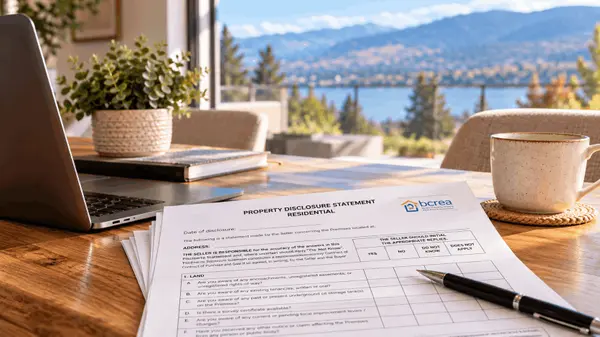
A Property Disclosure Statement (PDS) is commonly used during a sale, although completing a PDS itself is not mandated by BC legislation. Separate disclosure obligations can still exist regardless of whether a seller completes one.
If you know about an issue with your property — particularly something involving unpermitted work, water intrusion, structural issues or another potentially significant defect — discuss it with your REALTOR® before deciding what needs to be disclosed.
When necessary, legal advice should also be obtained.
Central Okanagan Property Issues Sellers Should Think About
One advantage of working with someone familiar with the local market is knowing which property issues are likely to come up during a buyer's due diligence.
There are several that are particularly relevant around the Central Okanagan.
If you're comparing the two largest markets on either side of the lake, my Kelowna vs. West Kelowna guide also covers some of the differences between the communities.
Wildfire and Insurance
Wildfire is part of living in the Interior, and insurance can become particularly important during periods of elevated wildfire activity.
Insurers may temporarily restrict new policies in areas facing an imminent wildfire threat, which can affect buyers trying to arrange insurance before completion. Existing policy renewals are treated differently.
If you're planning to sell during wildfire season, it's worth discussing insurance and timing early rather than discovering an issue once you already have an accepted offer.
For more about our climate and wildfire smoke, see Weather in Kelowna: What to Expect Year-Round.
Poly-B Plumbing
Some older Okanagan homes contain Poly-B plumbing.
The presence of Poly-B doesn't automatically mean there is a problem with the home, but it can affect a buyer's ability to obtain insurance or the terms an insurer is willing to offer.
If you know your home has Poly-B, it's better to understand the potential implications before listing rather than being surprised when it comes up during a buyer's inspection or insurance inquiry.
Secondary Suites and Unpermitted Improvements
Suites are extremely common in the Central Okanagan and can be a valuable feature for buyers.
But there's an important distinction between simply having a suite and having one that meets applicable registration, zoning and permitting requirements.
In Kelowna, secondary suites must be registered with the City, and unregistered or non-compliant suites may require legalization or decommissioning. Unpermitted improvements can also create disclosure issues.
If your home has a suite, carriage house, addition or substantial renovation, gathering the permits and documentation before listing can save a lot of scrambling later.
Wells, Septic and Acreage Properties
Rural properties come with another layer of due diligence.
If your property has a septic system, gathering available records, maintenance information and system documentation before listing is helpful.
For homes on private wells, buyers may also want information about water quality and quantity. HealthLink BC recommends regular bacteriological testing of private well water, although testing specifically because a property is being sold isn't a universal legal requirement.
Properties within the Agricultural Land Reserve can have additional restrictions as well, so sellers should understand their property's ALR status and any relevant approvals before going to market.
Selling a Leasehold Property
Leasehold properties are another important part of the Okanagan real estate market, particularly on Westbank First Nation land.
Selling leasehold property can involve different considerations around financing, remaining lease term and marketability.
Rather than getting into all of those details here, I've put together a separate guide:
Leasehold vs. Freehold Property in the Okanagan: What Buyers Need to Know
If you own a leasehold property, it's worth understanding these differences before listing.
Selling a Strata Property in the Central Okanagan
If you're selling a condo or townhome, buyers will usually want to review considerably more than the physical condition of your unit.
They may review documents including:
- Form B
- Strata bylaws and rules
- AGM and council meeting minutes
- Financial statements and budgets
- Insurance information
- Special levies
- Depreciation reports
One particularly important change is happening right now.
Most strata corporations with five or more strata lots are required to obtain depreciation reports on a five-year cycle. For most of BC outside the regions subject to the earlier deadline, including the Central Okanagan, the transition deadline is July 1, 2027.
That means some local strata corporations may still be working toward compliance.
If you're considering selling a strata property, checking the status of your depreciation report and gathering documents early is a very good idea.
Understanding Offers
Price gets most of the attention, but the highest-priced offer isn't automatically the most attractive offer for every seller.
Offers can differ in several important ways:
- Purchase price
- Deposit
- Financing conditions
- Inspection conditions
- Strata-document review
- Completion date
- Possession date
- Included or excluded items
- Other negotiated terms
For example, one offer may be slightly lower but have dates that work significantly better for your next purchase.
Another might have fewer conditions.
The right decision depends on your priorities.
In a multiple-offer situation, there are also specific rules governing how offers are handled and what information a listing licensee can disclose to competing buyers.
What Does It Cost to Sell a Home in BC?
Your actual selling costs depend on the property and transaction, but sellers should generally budget for some combination of:
- Real estate remuneration/commission
- GST on professional services
- Lawyer or notary fees
- Mortgage discharge costs
- Possible mortgage prepayment penalties
- Strata documentation or move-out fees, if applicable
- Repairs or preparation
- Moving expenses
- Property-tax adjustments
Real estate remuneration in BC is negotiable. There isn't a government-set or BCFSA-set standard commission rate.
One cost I recommend checking especially early is your mortgage payout.
If you're breaking a mortgage before the end of its term, a prepayment penalty can sometimes be significant. Your lender can tell you what would apply to your specific mortgage.
What About Capital Gains Tax?
For many homeowners selling their principal residence, the Principal Residence Exemption means the gain may be exempt from tax.
But there's an important detail people sometimes miss:
The sale still generally needs to be reported to CRA even when the full Principal Residence Exemption applies.
Tax considerations become more complicated if the property:
- Was a rental or investment
- Wasn't your principal residence for the entire time you owned it
- Changed between personal and rental use
- Was substantially renovated
- Was owned for a relatively short period
- Is being sold by a non-resident of Canada
There are also two separate property-flipping regimes to be aware of: a federal rule involving properties generally held for fewer than 365 consecutive days, and BC's separate Home Flipping Tax, which can apply to properties disposed of within 730 days. Each has its own rules and exemptions.
Tax situations can become complicated quickly, so this is an area where I recommend speaking with an accountant about your specific circumstances.
When Is the Best Time to Sell in Kelowna?
There isn't one month that's automatically best.
Yes, our market has seasonal patterns. Spring and early summer often bring more listings and buyer activity, while winter is generally quieter.
But that doesn't mean spring will produce the best result for every property.
The answer depends on things like:
- Your property type
- Your neighbourhood
- How much competing inventory is available
- Current buyer demand
- Interest rates
- Your personal timeline
- Whether you're also buying
- How the property presents during different seasons
A lake-oriented property may benefit from summer presentation, for example, while another property may actually benefit from listing when there is less competing inventory.
I'd rather look at current market conditions and your individual situation than choose a listing date simply because of the season. The available research doesn't support a universal “spring is always best” rule for Central Okanagan sellers.
Buying and Selling at the Same Time
This is where planning becomes particularly important.
Ideally, we start talking about your next move before your current home goes on the market.
Depending on your situation, options may include coordinating completion and possession dates, making a purchase subject to the sale of your existing property, exploring bridge financing once you have a firm sale, or arranging temporary accommodation between properties.
There isn't one strategy that works for everyone.
Your finances, risk tolerance, current market conditions and the availability of the type of home you're hoping to purchase all matter.
If your next move is within the area, my Moving to Kelowna guide is another helpful place to start planning.
What Should You Gather Before Selling?
You don't need to have everything perfectly organized before calling a REALTOR®, but getting a head start can make the process easier.
Useful items include:
- Your latest property-tax notice
- Mortgage information, including maturity date and potential payout penalties
- Recent BC Assessment notice
- Renovation records and receipts
- Building permits
- Warranties
- Utility information and service details
- Strata documents, if applicable
- Lease documents for leasehold property
- Tenancy information, if applicable
- Septic or well records
- Insurance information
- A list of items you'd like included or excluded from the sale
For rural properties, confirming ALR status can also be helpful.
You don't need to delay reaching out because you're missing something — part of my job is helping you determine what we'll actually need for your particular property.
Meghan's Local Insight
One of the biggest mistakes I see homeowners make is thinking about selling as a single event: put the house on the market and see what happens.
I think it's much better to work backwards.
Where are you going next? When would you ideally like to be there? Are you buying another home? Do you have a mortgage penalty to consider? Does your property have anything — a suite, strata documents, leasehold land, Poly-B, septic, a well or past renovations — that we should sort out before buyers start asking questions?
Those conversations can happen well before you're ready for a sign on the lawn.
And sometimes the best advice is to make a few changes before listing. Other times, it's to leave the home exactly as it is and not spend money unnecessarily.
The strategy should fit your home, your market and your next move.
Frequently Asked Questions
Do I have to renovate before selling?
No. Whether improvements make sense depends on the condition of your home, comparable properties and what buyers expect in your particular market.
Is my BC Assessment the value I should list at?
Not necessarily. BC Assessment uses a valuation date of July 1 of the previous year and is designed for property-tax assessment purposes. Current market value can be higher or lower.
Do I have to accept a full-price offer?
No. Sellers aren't obligated to accept an offer simply because it matches the listing price. Price is only one part of an offer.
Should I sell before I buy?
It depends on your finances, the current market and how comfortable you are carrying the risk of either owning two properties temporarily or selling before finding your next home.
Do I need a lawyer or notary?
A lawyer or BC notary typically handles the conveyancing and legal transfer of the property. A REALTOR® cannot perform that role.
How far ahead should I contact a REALTOR®?
You don't need to wait until you're ready to list. Starting the conversation earlier gives you time to understand your home's value, prepare properly and plan your next move without rushing.
Continue Exploring the Living Okanagan Resource Centre
If you're planning a move in or around the Central Okanagan, you may also find these helpful:
🏡 Moving to Kelowna: The Complete Guide
📍 Best Neighbourhoods in Kelowna
🌦️ Weather in Kelowna: What to Expect Year-Round
⚡ Utilities in Kelowna: What to Set Up When You Move
🏠 Leasehold vs. Freehold Property in the Okanagan
Thinking About Selling?
You don't need to have everything figured out before reaching out.
If you're thinking about selling a home in Kelowna, West Kelowna, Lake Country or the surrounding Central Okanagan, I'm happy to sit down with you, look at your property and current market conditions, and talk through what your options could look like.
No pressure — just a practical starting point for figuring out your next move.
Categories
Recent Posts